Latest News

Andrew's horror novella, 'The Bathtub', is now available.

Sunday, 10 June 2018

The Faerie Handmaiden of Annwyn – Cover

Faerie BigHere it is!  ‘The Faerie Handmaiden of Annwyn’ now has a cover. 

I think it’s great, not only in its own right, but because it ties in with the Welsh dragon on ‘The Footholder’s Tale’, my other Rebel ePublishers novel set in Wales’ remote past.

I don’t have a release date yet, but we’re in the final throes of editing at the moment so it should hit the virtual shelves before too long.

Sunday, 3 June 2018

Welcoming Ian Barker

I’d like to welcome author Ian Barker, a fellow writer published by Rebel ePublishers, to talk about his work and how he approaches his writing. Ian’s Rebel publications are ‘Fallen Star’, about how a rock star copes when his band splits, and ‘One Hot Summer’, which evokes youthful memories of the scorching summer of 1976, which I remember well. He has also authored ‘Late Show’, a collection of short stories, some of which previously appeared in magazines and anthologies.
Itsme2_preview.jpeg
Ian comes from Chesterfield, Derbyshire, and currently lives near Bolton in Greater Manchester. He has a background in writing, as a staff writer and then editor for various computing magazines, and also had sketches broadcast on BBC Radio 2's ‘The News Huddlines’. He is now a freelance technology writer, and, as his Twitter page says, a nice bloke.

So Ian, your novels, shorts, etc, are on a variety of subjects and genres. Where do your ideas come from? Does a common theme run through your different stories?

As far as novels go they’re mostly on a coming of age theme or perhaps more accurately – especially in Fallen Star’s case where the characters are a bit older – finding a better understanding of life, ‘coming of sage’ if you like. The short stories, to some extent, follow this theme too though they are rather more varied, mainly because many of them were written in response to prompts and contests on writer’s website I belonged to for many years.

Given your wide variety of subjects, do you need to change styles for each story? How do you cope with the different needs of each subject and with the change between shorts and the longer form?

Good question, I always try to make my stories character driven, so the style of the writing tends to come from the people I’m portraying. I find that sometimes this can be quite subconscious so, for example, if I’m writing about a character who works in a kitchen I’ll find myself using food similes. I quite like the constraint imposed by short pieces, they’re a good way of forcing you to focus on what’s important for telling the story, you need to make every word count. That can prove useful when it comes to writing a novel as you’re less tempted to pad out the text with unnecessary descriptions or peripheral events.

Your background is in the media, writing for radio etc. Did that ready you for the long slog of approaching a novel, or did the writing process spring any surprises? Did you learn any new lessons while doing the novel?

Did it ready me for writing a novel? Absolutely not! Writing a novel is a very different process and, for me anyway, a much harder one. You have the space to develop themes and characters in more detail, but at the same time you have to sustain things over a longer period. You also need to plan ahead to avoid writing yourself into a corner, a trap I’ve fallen into more than once. It’s also the case that when writing is your day job it can be hard to find the motivation to do it in your spare time as well.

How long on average does it take you to write a book, from planning to polishing, ready for submission? How much of it is research/planning/editing, and how much the actual producing?

At least three years. I tend to start with a fairly loose idea of what I want the book to be about and go from there. Research is usually undertaken as I go along – the IRA stuff in Fallen Star for example – as required by the plot, so it’s difficult to say what proportion of time is spent on that as opposed to writing. I also like to write the ending of a novel fairly early in the process so that I have a target to aim for. I’d say editing and polishing accounts for at least a year after completing a first draft. I also think it’s important to establish a bit of distance before starting to edit, so I like to put the completed draft aside for a month or so then come back to it with a fresh perspective.

You have an easy, relaxed style of writing and tell stories through characters, not through yourself, and to this reader it seems you write with your feet up. Presumably it’s not as easy as your output makes it look, but is your style natural, or has it taken a lot of honing?

One of my school English reports from when I was about 12 says, “Ian has an easy style and interesting ideas,” (thank you, Mrs Watmough). So I guess there’s a degree of natural talent, but it does take a lot of polishing to achieve especially at novel length. One of my writer heroes is the late Douglas Adams, his writing flows effortlessly into your brain, but it’s well known that he used to agonise over every word.

I think this is an area where media work does actually help as it teaches you to put across sometimes complex ideas in a way that is accessible to non-expert readers. Reading your work aloud helps, if you stumble over something it’s an indication that readers will too.

Fallen Star
Fallen Star takes us to the glamorous (or in places not so glamorous) world of rock bands. Have you ever played in a band, or been associated with the music business? If not, how did you research the background? – I’m no expert, but it all seems realistic to me.

The book was inspired by my catching a reality TV show – the BBC’s ‘Fame Academy’ circa 2002/3 – in which people were trying to become pop stars via a sort of hot house process where they were all locked up together. It started me thinking about what would happen if you turned the situation on its head, began with someone who had become a star almost by accident and you suddenly took their fame away.

I haven’t been in a band myself, research came from reading magazine interviews with music industry figures - ‘The Word’ magazine, sadly now defunct, was a particularly good source – and biographies of musicians and music journalists. What became clear from a lot of this was that real life in the music business was sometimes a lot less believable than fiction and that I’d have to tone things down a bit!

I was really impressed by the way the characters slotted into the story, and each had a part to play without seeming forced into their role. The characters are strong and defined, interact naturally, and are all skillfully woven into the plot. What came first; the plot that needed these characters, or did you start with these people, and mould the plot around them?

The plot came first. The basic idea of taking away fame gave me Karl. I realised I’d need conflict so the father who disapproved of his career choice was the next step. That then deepened by adding in Gerald’s military background and love interest Lizzie’s Irish republican connection. Road manager Graham – as you might have noticed – also appears in One Hot Summer, this is because the books were written in the ‘wrong’ order, OHS I wrote and collected a pile of rejections for first and then bottom-drawered it while I wrote Fallen Star. I intended Graham to be a walk-on character in the second book, much in the way Nick Hornby slips characters from ‘High Fidelity’ into his later novels, but as the writing progressed he rather built up his part.
fsfinal1_previewohs_cover_preview

One Hot Summer
I remember the summer of ’76 with some fondness myself, particularly the heatwave and droughts and standpipes. For those readers who too young to remember it, could you outline some of the joys of the mid-seventies, particularly those influencing the story?

Journalists and documentary makers often seem to give the 1970s a bad press. While the ’60s are flower power and ‘All You Need is Love’, the ’70s are power cuts and ‘Part of the Union’. But, while that view is true to some extent it’s become a cliché, the ’70s were also a great time – especially if you weren’t burdened by adult responsibilities.

Economically living standards in the UK were relatively high and people began to be able to afford luxuries like foreign travel, colour TVs and central heating for the first time – no more waking up with frost on the inside of the windows as I remember from being a child in the ’60s. Popular music had built on the previous decade and developed sub-genres like prog and glam, and of course was working up to the explosion of punk. This cultural experimentation was reflected elsewhere too on TV, for instance, you had the anarchic comedy of ‘Monty Python’ and ‘The Goodies’, and gritty new dramas like ‘The Sweeney’.

Compared to today it was also in many ways a more innocent time, no internet, no mobile phones and only three TV channels, which all went off after midnight. And of course in 1976 the weather was excellent.

The decade does seem to have been undergoing something of a reappraisal of late with increasing numbers of books, films and TV dramas being set in the ’70s. I hope I’ve made some small contribution to that, though I’m conscious that we might be slipping into a costume drama, Jane Austenised version of the time. I also find myself becoming a ’70s pedant, spotting errors in period detail.

You get deep inside the teenage John Burton, who is a compelling character. Was it difficult to write from the teenage viewpoint?

I started with the advantage that I was a teenager in the 1970s, so there’s a certain autobiographical element to the book. Music plays a part here too, there’s nothing quite like a tune to provide an instant mental link to a time and place – hearing ‘Bohemian Rhapsody’ takes me back to the sixth form common room every single time. I also suspect that most men don’t really grow up all that much after the age of 18, so it wasn’t as hard as you might think. Oddly what I found much more difficult was portraying the parents, who would in 1976 have been about the age I was when I was writing the book.

Links

Ian’s web page
Twitter: @iandbarker
Amazon
One Hot Summer
Fallen Star
Late Show

Tuesday, 1 May 2018

The Faerie Handmaiden of Annwyn

My next novel has a title! 

My story of Pelling and the fairy maiden he falls for had the working title of ‘The Fairy Wife’ which I didn’t like.  Jayne at Rebel ePublishers has suggested ‘The Faerie Handmaiden of Annwyn’ which I like, so we’ll go for that.

We’re still discussing whether the spelling of the Celtic Otherworld, and where Penni lives, should be Annwn (modern) or Annwyn (traditional). 

The story is being edited at the moment, and as usual Jayne is doing a thorough job.  I don’t have a release date yet.

Wednesday, 28 February 2018

Bathtub

I’m chuffed to announce another acceptance.  ‘Bathtub’ is a splatter horror novelette about a woman (Lizzie) and two men who are trapped in or around a bathtub, and the horrors they go through at the hands of a tormentor.  It was great fun to write and I’m delighted an editor likes it.

As usual, I’ll not give the publisher’s name until contracts are signed – ‘just in case’.  It’s house I’ve not worked with before but who I’m delighted to be with.

Tuesday, 2 January 2018

Writing Review of 2017

I’m jumping on the bandwagon again as I do every December, and doing a review of my writing year.  So, here’s what has happened in my writing world in 2017.

I’ve had two erotic shorts published, both featuring (so some extent) my favourite PhD student, Kerry-Jane.  ‘Eton Mess’ stars Kerry-Jane and Amy, her best friend.  The duo go out for a meal and enjoy the contents of the sweet trolley perhaps a little too enthusiastically, to the delight of their two waiters.

Eton Mess SmallWeekendTreat Small

Weekend Treat’ is a story around Rachel, Kerry-Jane’s supervisor, who thinks in her early thirties she is too old to be attractive.  The attentions of two handsome plumbers have her realising she’s still got it. Rachel was introduced to the world in my time travel novel, ‘The Door into War’, and this short develops some aspects of her character I couldn’t work on in the book.

Elsewhere my novel, ‘The Fairy Wife’ was accepted by Rebel ePublishers and is likely to be published in 2018.  It’s a similar story to ‘The Footholder’s Tale’ that Rebel published in 2015, being a retelling of a traditional Welsh story and set in the remote past.  Like ‘Footy’, this was great fun to write and I’m delighted Jayne at Rebel has taken it on.

So, what else do I have to look forward to in 2018?

Well…

  • I’ve got a handful of finished horror novels and novellas hanging around which I’m quite pleased with.  They’ll be looking for publishers;
  • A few more erotic shorts, as usual ‘starring’ Kerry-Jane;
  • I’m in the final stages of a violent horror set around Irish myth;
  • I’m in the planning stages of a couple of novels.  I’m not sure what I’ll write next – it looks like a toss up between a horror based around a heavy metal band, and a fantasy-horror set against the backdrop of witchcraft in the mid-seventeenth century English Civil War;
  • Several years ago I wrote a horror novel (‘Dana’s Children’) about a group of archaeologists who come across some creatures from Celtic myth.  The story was accepted by Wild Child Publishing before the house folded, and has been professionally edited.  I might consider self-publishing it this year.

Finally, I’d like to give a big thanks to everyone who helped with my writing in 2017, especially Carole and Phil.

    Sunday, 3 December 2017

    Site Updated

    After a bit of a delay caused by other projects (and, I admit, a bit of laziness and a lot of technophobia) I’ve found time to update this blog. 

    My ‘Publications’ page is now up to date. 

    I’ve also updated my ‘Reviews’ page.  If anyone out there has read any of my books and feels like adding a rating – or even a few comments - on either Amazon or Goodreads, that’d be great.

    Sunday, 12 November 2017

    Welcoming Nancy Avery Dafoe

    I’d like to welcome author Nancy Avery Dafoe and her new book, ‘You Enter a Room’, published by Rogue Phoenix Press.  During this book tour, Nancy will give away a digital copy to a lucky commenter.
    BANNER-You-Enter-a-Room-web

    ISBN: Ebook 978-1-62420-339-8

    Print 978-1977744630

    Author: Nancy Avery Dafoe

    Genre: suspense

    Excerpt Heat Level: 1

    Book Heat Level: 2

    Buy at: Amazon, Barnes and Noble

    TAGLINE

    Advena Goodwin didn’t set out to become a detective. She would rather write her dissertation and fall in love, but her friend has been murdered.

    BLURB

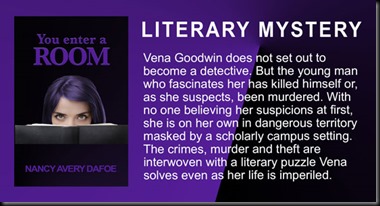
    You Enter a RoomHeroine Advena (Vena) Goodwin does not set out to become a detective. She is more interested in untangling a literary mystery, writing her dissertation, and falling in love, but the young man who fascinates her has killed himself or, as she suspects, been murdered.

    A smart, resilient young woman, Vena attempts to trap the clever murderer Professor Gould by using his over-sized ego against him. With no one believing her suspicions at first, she is on her own in dangerous territory masked by a scholarly campus setting.

    This upmarket murder mystery takes place in the settings of Rochester in upstate New York and Rome, Italy. The crimes, murder and theft, are interwoven with a literary puzzle the protagonist solves even as her life is imperiled.

    EXCERPT: You Enter a Room

    “Yeah, well, they meant business, so I knew something was going down there. After circling the house, the cops pounded on the door again, then one of them looks through a window he’d already passed and returned to, standing on his toes, and yells something. The other one comes back to the front, or I guess, really a side door, and starts kicking at it. Then both of them were smashing their boots against the door. I mean, I’ve seen this kind of smash in the door on TV, but to actually see these guys break something down is damned impressive.”

    Suddenly, I wanted him to slow up and not say the next part out loud, but Sam urged him on. “Then?”

    “They went in, and I ran across the street like I was still jogging and looked in the open doorway because I guess I wasn’t thinking about anybody having guns, and I realize that wasn’t the smartest thing for me to do—see, I wasn’t even thinking about myself at that point.”

    “Andrew!” I wanted to slap him.

    “It was awful, really. This guy, he was hanging from the ceiling fixture at the top.” I covered my face and Sam gripped my arm, her painted nails digging in and leaving little impressions. “They were trying to get him down, so they didn’t see me. One cop grabbed his legs and pulled him back to the top of the stairs to check for a pulse. Then he let him go, accidentally, I think, and the guy starts swinging back and forth like a pendulum. I stepped back then because I’d never seen a dead person hanging like that, and that’s when I saw his boot at the bottom just inside the door. One of his boots was still on, but the other had fallen. I was so close that I could have picked it up. I went back to the other side of the street and called my friend Jay to come get me. I was starting to feel sick.”

    At first the detail of the boot seemed pointless and then I saw the image as clearly as Andrew had, marking the death of the individual. Michael’s boot, the worn, old leather ones that he wore every day. “How do you know the shoe or boot was Michael Lawler's?” Sam asked. “Did you know him?”

    “No, never heard of him, but when an ambulance pulled up and the EMTs went in, I was still waiting for my friend. Jay had been sleeping in that morning because he didn’t have class, so he wasn’t there yet. See, I didn’t feel like running anymore, I was nauseous, like you.” He looks at me, then said, “Just like you. Another cop came and took pictures, then they brought out his body covered up like on a TV show. One of the cops said to the other, ‘Anything in his pockets?’”

    ““License says Michael Lawler,” I’m pretty sure the cop said. “Student ID on him too. University of Rochester student. Suicide.” I didn’t want the cops to notice me, so I stepped back further and ducked around behind a house. Thinking about what I did now, maybe it wasn’t such a good idea because they might have thought I had something to do with it, like I was involved in a murder or something. I mean, he was hanging, but who knew how he got there, even if he did say suicide?”

    “Oh, no,” was all I could get out. Sam was crying. Looking back later, I realized Andrew might have been the one to put the word 'murder' in my head.

    “You’re sure?” Sam asked, and he nodded. I liked Sam a little bit more during those moments we were drawn together in horror. Whatever else life held for either of us, we experienced a temporary bond in that claustrophobic space where breathing becomes more difficult.

    Andrew waited a few minutes but saw that neither one of us was up to questioning him further, so he walked off, ready to repeat his tale. He probably had friends back home who had yet to hear of his dramatic morning. That would be all the experience was for Andrew, an opportunity to enlarge his life.

    Sam hugged me, and I took that solace greedily. We finally stopped holding one another. “You okay?” she asked.

    I nodded, “I can’t believe it.”

    “Me either. I’m so sorry, but I’ve got to go,” and we parted. As soon as I left the bookstore, I was hit again, my whole body aching. By the time I reached my apartment, my head hurt so badly that I turned off the lights, pulled the curtains, and rolled into a fetal position on my bed where I stayed for hours. It didn’t help and changed nothing. Hours later, I woke to restless fear and more nausea.

    Although I didn’t know Michael well, I was aware of his peculiarities, his withdrawn silence, his intelligence and gentleness. What was certain was I wanted to know him better. What I recognized him best for, however, was his talent. We had read each other’s work on multiple occasions, wrote a few comments that were generous rather than critical. I couldn’t quite believe that Michael had taken his own life, that he was gone. Logically, my search should have ended there with his death and certainty. We were told he had hanged himself. Everything should have been obvious, as related circumstances appeared to be to nearly everyone around me, but suicide and Michael did not fit, would never fit.

    My mind kept seeing Michael’s worn boot at the bottom of the stairs and then him swinging when the cop let go of his body either accidentally or deliberately. Unlike Andrew, I was not a witness, had not been at the crime scene, but I might as well have been because I conjured up the sight as clearly as if I had been standing outside in the snow, looking through that open doorway. My eyes followed a line of dread up narrow stairs in disbelief, but I kept turning away before seeing his distorted face, as if I couldn’t bear to look at him in death, even in imagination.


    AUTHOR BIO:

    Nancy Dafoe picWriter, poet, and educator Nancy Avery Dafoe, Homer, NY, has published books on teaching writing, Breaking Open the Box and Writing Creatively: A Guided Journal through Rowman & Littlefield Education in 2013 and 2014, respectively. Her latest book on education policy, The Misdirection of Education Policy: Raising Questions about School Reform was published by Rowman & Littlefield in June 2016. Her first chapbook of poetry, Poets Diving in the Night, is due out from Finishing Line Press in January 2017.

    She recently won the William Faulkner-William Wisdom creative writing award in poetry for 2016 and previously won the New Century Writer award for short stories. Dafoe’s poems, essays, and stories have appeared in numerous literary publications. Her fiction work also appears in the anthology Lost Orchard, published by SUNY Press in 2014.

    KEYWORDS

    Murder mystery; Woman amateur detective

    Website URL: https://www.nancydafoefiction.com/

    Blog URL: info@dafoenteachingwriting.com

    Facebook page: Nancy Dafoe, Nancy A. Dafoe, Dafoe Writing and Consulting